Psilocybe mexicana
R. Heim · Psilocybe sect. Mexicanae
Teonanácatl · Pajaritos · Mexican mushroom
The species from which Albert Hofmann first isolated psilocybin in 1958, and the one used in the Mazatec ceremonies that brought these mushrooms to Western attention. Modest potency; it also readily forms sclerotia, which are sold as truffles.
1 deadly look-alike. Pholiotina rugosa can be mistaken for this species and causes irreversible organ damage. How to tell them apart.
Potency
- Psilocybin
- 0.1–0.63% of dry weight
- Psilocin
- 0–0.2% of dry weight
- Total tryptamines
- 0.15–0.8%
- Relative to cubensis
- 0.71×
Similar to or somewhat weaker than cubensis on the few assays that exist: Hofmann's group reported 0.2–0.4% psilocybin in dried mushrooms, and a 2022 analysis of one collection found about 0.33–0.39% psilocybin plus 0.2% psilocin. Sclerotia (truffles) are dense and much wetter when fresh, which confuses comparisons badly.
Dose ranges for this species
| Tier | Dried | Psilocybin-equivalent | What to expect |
|---|---|---|---|
| Threshold | 0.42–0.7 g | 1.9–3.2 mg | Mild body load, slight colour and texture enhancement, mood shift. |
| Light | 0.7–1.4 g | 3.2–6.3 mg | Clear perceptual change. Surfaces breathe, emotions amplify, time distorts mildly. |
| Common | 1.4–3.5 g | 6.3–15.8 mg | Full psychedelic effect. Strong visuals with eyes closed, altered thought, emotional intensity. |
| Strong | 3.5–7 g | 15.8–31.5 mg | Ordinary self-reference goes. Marked visual distortion, time stops behaving. |
| Heavy | 7 g and above | 31.5 mg and above | Complete disruption of the ordinary sense of being a person in a place. |
Scaled from the standard dried-cubensis tables by this species’ representative alkaloid content. Because that content varies between flushes, treat every figure as an estimate and start below it. Open the full calculator.
Identification
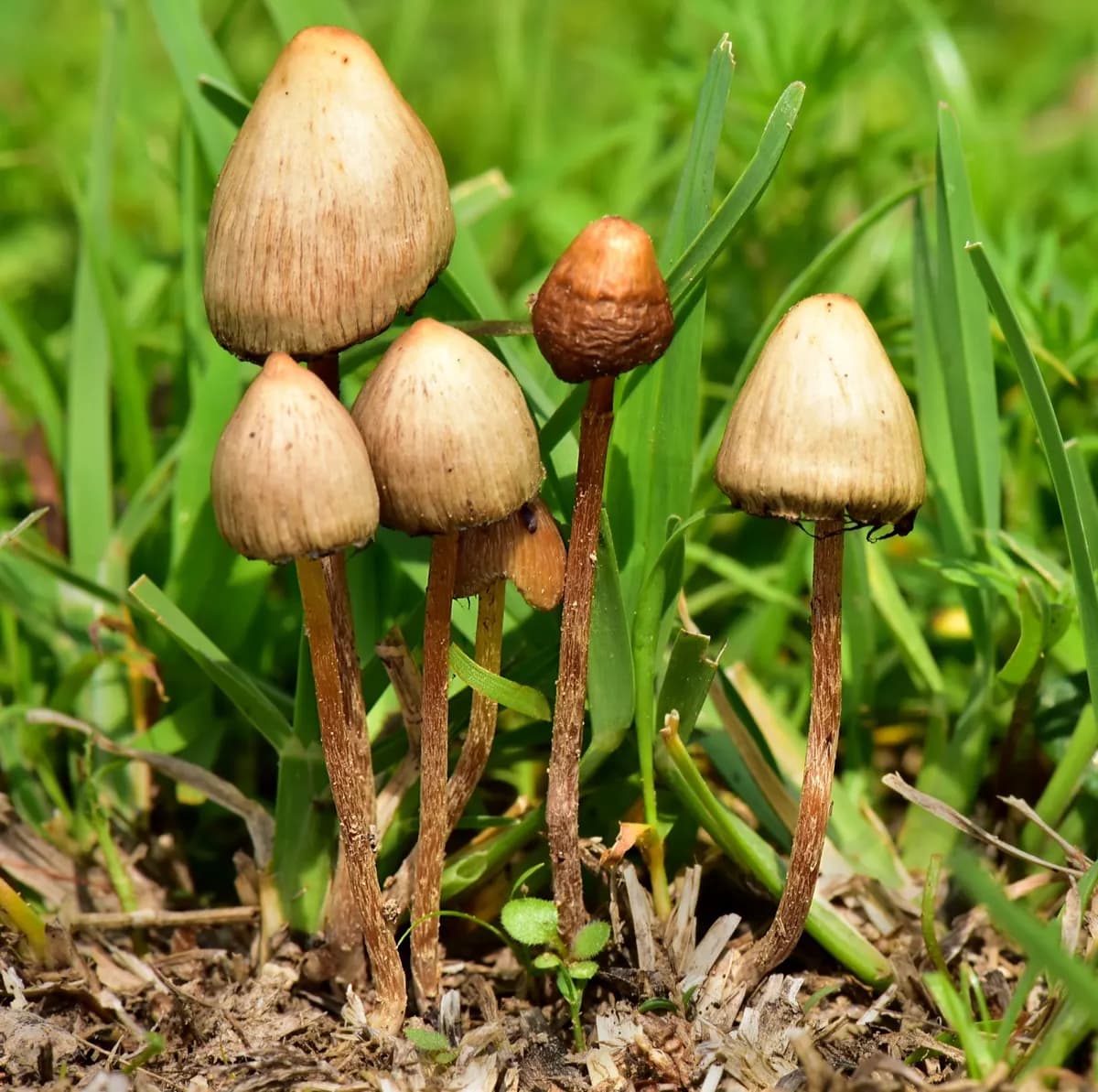
Easiest way to tell: A small bell-shaped straw-coloured cap on a very slender stem, in high-altitude Mexican grassland and moss.
- Cap
- 0.5–3 cm, conical to bell-shaped with a small umbo, straw to brownish, hygrophanous.
- Gills
- Adnate, greyish becoming purple-brown.
- Stem
- 4–12 cm, very slender, straw-coloured, weakly bruising.
- Ring
- Absent.
- Flesh
- Bruises blue weakly and slowly.
- Spore print
- Dark purple-brown
- Bruising
- Weak and slow
Habitat
- Substrate
- Mossy grassland, Roadside banks, Meadows near deciduous forest
- Regions
- Central and southern Mexico, Guatemala, Costa Rica
- Season
- May to October, the Mexican rainy season
Typically at altitude, between 1000 and 1800 metres.
Look-alikes
Compare every mushroom look-alike of Psilocybe mexicana side by side, or read the full look-alikes guide.
Cultivation
Straightforward, and the standard source of sclerotia. Truffle production takes a few months in the dark rather than a fruiting chamber, which is why it is the species behind most legal Dutch truffle sales.
Cultivation guidesMedication interactions
These interactions come from psilocin itself, so they apply to every species; a more potent species means a larger dose of it. These medications are graded dangerous, caution, increases or not studied on Fungodex. Not listed here does not mean safe; check the full checker covers 24.
- LithiumDangerous
- MAOIs (irreversible)Dangerous
- TramadolDangerous
- Moclobemide and other RIMAsCaution
- Harmala alkaloidsCaution
- BupropionCaution
- Tricyclic antidepressantsCaution
- St John's WortCaution
- StimulantsCaution
- AntipsychoticsCaution
- DextromethorphanCaution
- AlcoholCaution
- CannabisIntensifies
- TriptansNo data
- 5-HTP and L-tryptophanNo data
- MAO-B inhibitorsNo data
Sources
- [1]Stamets, Psilocybin Mushrooms of the World (1996)
How we research this: sources, evidence grading, review and updates.